
Your Cheat Sheet to a Local Thanksgiving
Posted: November 5, 2013 Filed under: Food, Local Food, Thanksgiving | Tags: Eating Locally During Thanksgiving, Thanksgiving, Thanksgiving Food 1 Comment However you define eating locally, whether it’s strictly food from within a 100 mile radius, simply domestically grown or made foods, or somewhere in between, one of the best times to be conscious of where your food comes from is during Thanksgiving. It may seem complicated at first, so we thought we’d provide a little help to get you started with some resources that can show you where to get locally produced foods in your area.
Let’s all give thanks to the great local producers who give us tasty foods from our own neighborhoods.
Here are the places to start your investigation:
 Gourmet Food Websites – there are a few websites that offer locally produced gourmet foods such as cheeses, cured meats, pickles, preserves and more, including our own www.aLocalTable.com (sorry for the shameless plug). These sites not only offer great food, but also convenience since they will typically ship or deliver the food right to you door.

Winter Farmers Markets – in some parts of the country, farmers markets are still running. There can be a lot of different producers at these markets, but make sure you ask them where their farm is located. Sometimes booths are set up with produce that is just bought from a national distributor and sold under the guise that it’s local. Here’s a link to help you find winter farmers markets in your area – http://search.ams.usda.gov/farmersmarkets/default.aspx
Local Food Bloggers – do a quick Internet search for food bloggers in your area. They typically write about great local sources for food (just like this guy). And if you don’t see anything written about local sources I’m sure the blogger won’t mind if you send them a message asking if they have any recommendations. Food bloggers are a social bunch so I’m sure you’ll get a warm response. www.google.com
 Local Slow Food Chapter – The Slow Food organization spans across this country, with chapters in most states. It’s mission is to get people to think more about the food they eat and support the local food producers around the country. Reach out to your local chapter either via their website or Facebook page and inquire about recommended sources for local foods. You’ll probably get more information than you need. You can search here for a local chapter near you – www.slowfoodusa.org/local-chapters
 Publishers/Magazines – don’t forget about the obvious places, such as culinary magazines, including Edible Communities Publications (and their website), which has many regional editions that write at great length about the local food scene in your area. They have 80 editions across the country all with localized editorial. Here is a link to their website – www.ediblecommunities.com
Local Supermarket – when all else fails, most supermarkets now have local food sections that may feature local produce, meat or gourmet foods, such as cheeses and cured meats. If you don’t see anything, be sure to ask the store manager. If they don’t have it on hand, they may be able to get something in before the holiday.
So now you have a starting point, begin planning and shopping. Make it a fun experience…and maybe if you reach out to some of the organizations mentioned above, you might learn something new, get new ideas or make new friends.
And of course, if you have any questions about local eating, you can always reach out to me at ken.kullack@alocaltable.com.
Happy local Thanksgiving!
Corn on the Cob: the essential summer memory
Posted: July 17, 2013 Filed under: Farmers Markets, Fresh Corn, Local Food, Salt | Tags: CobCorn, corn, corn on the cob, Cotija cheese, fresh corn, Jack Johnson, Maize, summer eating, summer food Leave a comment There aren’t many foods that can conjure up a more pleasant image of summertime than corn on the cob (at least in the United States). Many people have grown up eating it alongside hamburgers, hot dogs, potato salad and watermelon. A “barbeque” (as people outside the South would call it) wouldn’t be complete without an ear of corn slathered in butter with a generous grind of black pepper and sprinkle of kosher salt.
With one humble ear of corn we can travel back to a time of pool parties, lightning bugs and casual games of badminton, horseshoes or whatever your family’s game of choice. It’s hard not to smile, thinking about that simpler time.

For those who relate to emotions through music like I do, Jack Johnson said it best when he wrote, “and there were so many fewer questions when stars were still just the holes to heaven.” Corn on the cob brings us back to that much-needed youthful reminiscence as we live in this 24-hour age of over-communication and overcrowding.
As we get along in life, we realize that those moments are essential. We need to continue to share them with future generations so we as a society don’t forget about what should important to us.
That being said, I encourage you to go to your local farmers market this week, say hello to your local farmers and buy some corn. Invite some friends over and sip some wine or beer as you chat over a luscious ear of corn and make new memories.
To help get you started, I thought I’d share a few of the ways I like to eat corn on the cob. I’m sure there aren’t any new recipes here, but maybe this list will inspire you to try something different.
 Traditional – you know this one well, butter, salt and pepper. The twist on this one is to buy small farm, handmade butter. You’ll notice the difference.
- Smoked – this one is for those smoker-afficiandos: par-boil corn, then rub with olive oil and green onions and smoke for an hour at 225 degrees.
- Mexican-inspired – this one is all about adding flavor, which includes slathering the grilled cob with a mixture of crema and cilantro, a spritz of lime juice and a dusting of chili powder and cotija cheese.
- Greek-inspired – brush a luscious mixture of melted butter, feta cheese, lemon juice and mint onto grilled cobs.
If you’d like to share any of your favorite recipes, please include them in the comments below. We love new food experiences.
Happy summertime memories.
It’s Springtime and I’m on the Lam(b)
Posted: April 11, 2013 Filed under: Farms, Food, lamb, Local Food | Tags: cooking lamb, eating lamb, lamb, Lamb and mutton, lamb consumption Leave a commentOk, so maybe the title is a pretty lame pun, but this time of year always gets me craving one of most underrated meats in this country…lamb. It doesn’t hurt that I’m also betrothed to an Aussie who considers lamb it’s own food group and will eat it any chance she gets.

I read an interesting statistic that I haven’t been able to confirm, but according to this one article, about 70% of people in this country have never tried lamb. Even if the actual percentage is half that amount, it’s ridiculously low.
At one time in the US, lamb was raised mainly for Passover and Easter. Even though lamb is now being raised for year round consumption, the average person usually only thinks about eating it during the spring. In my opinion, there’s no reason it couldn’t and shouldn’t be eaten year round.
But There is hope!
Even though consumption is much lower than other meats, US consumption of lamb is actually on the rise. There are a few reasons:
- Open-minded chefs who have trained in or visited lamb-loving countries have been including lamb (and mutton for that matter) on their menus
- People who are migrating from the Middle East and parts of Europe and Australia into the United States are demanding their favorite meat

And There is Supply!
The quality of lamb raised in this country is better than people believe. Most of the local farms are raising grass-fed lamb that creates meat that has a more refined taste and texture. States such as Colorado and Washington are known for raising lamb, but there are many other states that have small farmers raising some great lamb, including Virginia, Vermont, Pennsylvania, Texas and California. Even in Utah, we have producers of some fine lamb, including Snowy Mountain Sheep Creamery and Morgan Valley Lamb.
There is Variety!
Aside from the perception that lamb tastes gamey, part of the resistance to eating lamb is the mystery behind how to cook it correctly. Since it’s versatile and flavorful there are many ways it can be prepared. And if you buy grass-fed lamb and pair it with complementary flavors, you won’t think there is any of that barnyard funkiness.
 Here are the most popular ways to prepare lamb:
- Roasted and stuffed leg
- Stewed shoulder with vegetables
- Grilled loin chops
- Broiled rack of lamb
- Braised lamb shanks
However, recently dishes such as braised lamb ribs and slow-roasted lamb belly are appearing on menus across the country along with other rediscovered cuts. Sign me up, please.

There is Flavor!
Now, there are a lot of classic flavor combinations with lamb, such as mint, rosemary, thyme, garlic, and lemon. These are stronger flavors that can stand up to the taste of lamb and you can’t go wrong with them. However, there are a number of other flavors you may not have thought about pairing with lamb. Here are a few suggestions:
almonds, anchovies, blue cheese, cherries, eggplant, lavender, oranges, pistachios, prunes, tamarind, vermouth, zucchini
OK, so I’ve probably said enough about lamb. After you’ve read this post, I hope you think differently about it. The next time you’re at the butcher or grocery store, consider buying lamb – and if you’re feeling adventurous, buy something other than lamb chops.
Thanks for your time and happy eating!
A Scorned Foodie Picks The NCAA Tournament
Posted: March 21, 2013 Filed under: Food, Local Food, March Madness, NCAA Tournament | Tags: Final Four, March Madness, NCAA, NCAA Men's Division I Basketball Championship, Picking NCAA Tournament 2 Comments
Every year I catch the fever that is called March Madness. I watch the selection show, scour the Internet and eaves drop on conversations around the water cooler, all to inform my NCAA tourney brackets.
Every year I sit back and watch as somebody else surpasses me in braketology and ask myself where it all went wrong. Maybe I’m just not suited for predicting college basketball games in March.
Every year I hear that the person who won the pool picked their brackets based on team mascot or team colors or some other extraneous criteria. Then I feel even worse. How could somebody who knows nothing about the sport beat me?

I have an Idea!
This year will be different. I’ve decided to use a unique selection process to choose my brackets. I thought long and hard about it and came to the conclusion –
Why not choose the teams based on their food pedigree. That sounds so ridiculous it just may work.
So here’s the criteria I used:
Teams that are in regions that have a strong food culture supersede a team from an area that is a culinary wasteland.
- Is there a strong farming community that thrives on sustainable, artisan foods?
- Do they make all natural, handmade foods in the region?
- Is there a strong restaurant scene near the school?
- Is the area known for a specific food that is unique and delicious?
My Picks
By using these new criteria, I worked through my bracket and came to the following final four teams:
 Midwest – From a food standpoint, probably the weakest collection of schools. However, there are a few standouts, including St. Louis, Oregon, Memphis and Duke. Based on their BBQ and whiskey, I’m giving this region to Memphis (6), though Oregon is a close second.
 West – This is a tough region. You have Southern University, Wisconsin and Gonzaga from parts of the country that feature great food. These three are all legitimate choices, but because cheese is one of my favorite foods, I’m going to have to choose Wisconsin (5).

South – I wouldn’t say this region features the obvious areas one would associate with a thriving food scene, but there are a few to note. North Carolina, UCLA, San Diego State and Georgetown are the best. I’ll have to pick Georgetown (2) because DC has such a great restaurant scene, it’s close to Maryland which has some of the best seafood on the east coast and not far from the pig farms in Virginia. Hard to argue with that one.

East – There are a number of contenders in this region. You have Cal in northern California, Marquette in Milwaukee, University of Miami, and Pacific (offering northern Oregon produce, hops for beer and wine grapes). So my heart says Pacific, but Cal is also a major consideration being close to farms, cheese makers and of course, Napa. This is too close to call and any of these teams could be a legitimate choice, but I have to go with Marquette (3) since it is in Milwaukee, which stands for brats, beer and cheese – some of my favorite food vices.

Of those 4 teams, I’ll have to award the NCAA Championship to…Georgetown (2). It offers great restaurants, fresh seafood and reasonable proximity to a great agriculture scene.
So there you have it. A few expected picks and a few surprises. Maybe I wouldn’t be that far off from these selections by choosing based on basketball ability, but I certainly had more fun in the process.
Have any opinions about my selections, please kindly respond below and let me know what you think.
Meet My Demands Or The Bird Gets It
Posted: November 21, 2012 Filed under: Food, Local Food, Thanksgiving | Tags: Gravy, holiday, Jazzercise, Thanksgiving, Turkey Leave a comment
OK, maybe these aren’t demands…and we all know this time of year the bird gets it in the end (usually to a delicious outcome)…so all subterfuge aside, here are my suggestions for making this Thanksgiving a gastronomic delight this year.
- You must have the bird. Yes, it was unlikely that turkey was served at the first Thanksgiving, but it eventually became a tradition and the end result is so delicious. There’s a lot of talk this year about serving other meats, but I personally couldn’t live without turkey’s versatile leftovers to make sandwiches, soups and so much more. You are only limited by your imagination. It is truly the gift that keeps on giving.

- This is probably the only day of the year that you shouldn’t substitute all of those rich ingredients in recipes. If it calls for cream, use it. If it calls for butter, use it. If it calls for bacon, enthusiastically cook up some porky goodness and serve it with a smile. If you’re that concerned about your health than do a few extra hours next week on the elliptical or with your Jazzercise video. (ignore this point if you have medical issues, I’m not a doctor, I only play one on TV)
- Side dishes and desserts are a fantastic way to be creative and try something new. Either take a traditional ingredient and turn it on it’s head or try an ingredient that isn’t typically associated with the holiday and add a Thanksgiving twist.
- Try to source as much of your ingredients from local producers. This time of year there’s so much great autumn produce and meat, you really don’t have an excuse…and your guests will notice and thank you. Maybe even write up little place cards for each dish and include the local source of the ingredients.
 Make sure you don’t forget the gravy. Pan gravy is the most sublime creation by humankind so be sure to make the extra effort to make it the best damn gravy ever (and lots of it for that matter).
- Lastly, have fun and get family and friends involved in the cooking. Everyone will enjoy the experience and it will bring the whole group closer together during one of the best holidays of the year.

If you have any suggestions of your own, please don’t hesitate to share with us.
Thanks for your time and Happy Thanksgiving!
The Pumpkin-ification of My Life (and yours)
Posted: November 6, 2012 Filed under: Farmers Markets, Food | Tags: Forrest Gump, Pepita, Pumpkin, Pumpkin History, Pumpkin Recipes, Tom Brady Leave a comment
All I had to do was poke around my kitchen a little to figure out the topic for my next post. It was right there staring at me. As I picked through my cupboard and refrigerator I compiled the list – pumpkin bread, pumpkin cupcakes, pumpkin beer, pumpkin puree, pumpkin seeds, pumpkin spices.
I guess it’s that time of year so one expects to eat more pumpkin related foods, but it made me realize how versatile and delicious the pumpkin really is – something I’ve taken for granted since I was a child. It’s time is due.
A little pumpkin fashion history
As I’m sure you all know, the pumpkin is indigenous to North America. Native Americans and the early settlers used it for sustenance (especially during the cold winters) as well as for medicinal purposes. No surprises there.

But did you know that the pumpkin also had an influence on fashion in the early colonies? According to one source, pumpkin shells were used as templates for cutting men’s hair. That’s why New Englanders were at one time called Pumpkin Heads. I guess this also explains Tom Brady’s hairdo.
Pumpkin: the versatile fruit
There aren’t many foods that can be used in almost it’s entirety. The pumpkin is one of them. Whether it’s the shell, seeds, blossoms or leaves, all can be used in culinary ways. And pumpkin can be used to create a diverse range of dishes, including soups, stews, sauces, pies, cakes, cookies, libations and so much more.
I’m sure you have your favorite pumpkin foods. Here are mine. (be sure to read this list in Bubba’s voice from Forrest Gump, the way he was listing all the ways to prepare shrimp.)

pumpkin ravioli, pumpkin marshmallows, pumpkin iced cream, pumpkin beer, pumpkin soup, pumpkin cupcakes, pumpkin vodka, pumpkin bread, pumpkin doughnuts, pumpkin lattes, pumpkin pancakes, pumpkin waffles, roasted pumpkin seeds, pumpkin cider, pumpkin enchiladas, roasted curried pumpkin, pumpkin muffins, pumpkin butter, pumpkin fudge, pumpkin cinnamon rolls, pumpkin gratin, pumpkin lasagna, pumpkin scones, pumpkin oatmeal, pumpkin french toast, roasted pumpkin seed brittle, pumpkin cheesecake, pumpkin bread pudding, pumpkin risotto, pumpkin margherita, pumpkin bagels, pumpkin panna cotta…
Ok, so maybe a little overkill, but you get the point.
My Predictions
Pumpkin is the new bacon with restaurant demand up 38% this year so expect to see it in places you wouldn’t expect, such as your local diner, food truck or favorite speakeasy. Knowing all of this, I’ve made some predictions for the next year regarding pumpkins. Remember, you heard it here first.
- Expect to see pumpkin blossoms (especially stuffed and deep fried) on the menus of some of the top restaurants in the country – replacing squash blossoms.
- Pumpkins will make a great impact on mixology, with many bartenders combining not only pumpkin spices, but also pumpkin purees with classic cocktail recipes.
- Someone will try to market a “pumpkin diet” extolling the nutritional value of pumpkins.
- Pumpkin mac and cheese will attain a cult following in foodie homes across America and will be served at many a Thanksgiving table this year.
- Lastly, Punkin Chunkin will be the number one show on primetime by 2014 (maybe not, but it’s a fun show). If you haven’t seen it yet, look for it on the Science Channel.
By now, you are hopefully inspired to at least puree fresh pumpkin for your Thanksgiving pie. Please be responsible and buy a local pumpkin from a farmers market or grocery store. Give some love back to our local farmers. They would do the same for you.
Thanks for your time.
Poutine, Potato Vodka and so much more…
Posted: October 17, 2012 Filed under: Boise, Cheese, Farmers Markets, Farms, Food, Idaho | Tags: Boise, Boise Idaho, Bronco Stadium, Cheese, Goat cheese, Idaho, Local food 5 Comments
Who knew that there’s such a vibrant local food scene in Boise? I didn’t know it. And I don’t mean Russet potatoes (though they are delicious)- it’s much, much more.
During our trip to Boise last weekend, we were pleasantly surprised at how much attention there is to eating locally. We were going to see a Boise State football game without any local foodie intentions. However, we were much surprised. I would like to share how we unexpectedly experienced the local food scene in Boise last weekend.
A late night snack
We arrived in Boise around 9pm after a 5 ½ hour drive. All we wanted was a good drink and a light meal before we went to bed. Located in downtown Boise, FORK was a delightful surprise.
We ordered a cheese plate with a number of locally produced cheeses, hand cut fries and what they called a tomato fondue with grilled cheese. The later is a unique twist on fondue where cubes of grilled cheese sandwich (made with local cheddar of course) were dipped into a creamy tomato-based soup. Try to tell me that’s not a comfort food-lovers delight.
It was during this meal that we learned about a farmers market from our server, so guess what we did the next morning before we hit Broncos Stadium…
 A morning excursion
Though it’s late in the season, farmers markets are still going strong in Boise with tables overflowing with various produce, grass fed beef (both fresh and jerky-d), local goat cheeses, wine from local vineyards and a cornucopia of pumpkins and squash.
We found Rollingstone, one of the Idaho cheese producers we tried the night before. They make a number of different goat cheese styles, but we bought their aged Chevre with ash strewn through the middle, along with a small log of their unbelievably soft, fresh goat cheese. Aged goat cheese is rare to this area, but they’re doing it right. I’d say it’s close to Vermont Creamery for those of you on the East Coast.
 A post-game snack
After catching a spirited game at Bronco Stadium where Boise State dominated Fresno State at the Smurf, we went to Bittercreek Alehouse for a few celebratory pints of local Idaho brew and an overflowing bowl of poutine (oh, what a hot mess). Yes, poutine is a Canadian invention, but when made with local Idaho potatoes, local cheese curds (Ballard Family Dairy) and gravy from locally raised turkeys, it raises the dish to a new locavorian high (yes, I just shamefully made up that word).
Dedicated to the local food movement, this alehouse lists the sources of all the local foods they serve. It gets updated everyday. Pretty impressive.

A pre-dinner cocktail
Even for an aperitif that evening, we acted as locavore. Can you say martinis made from locally produced vodka (specifically Blue Ice Vodka)? I guess it makes a ton of sense that Idaho would make vodka (and a good one at that). The Polish have been distilling potato vodka for centuries, why shouldn’t it be done in one of the most prolific potato growing areas in the world.
A conclusion
In retrospect, I guess the lesson here is that anyone can discover local food just about anywhere if you get out there and explore – there are plenty of new and stimulating experiences waiting for you so don’t miss out.
Please don’t hesitate to share with me any of your local food experiences, be it in Boise or any other part of this country.
Thanks and happy local eating.
My Breakfast of Champions (and it’s not what you think)
Posted: September 17, 2012 Filed under: apples, Breakfast, doughnuts, Food | Tags: Apple cider, Doughnut, Maple bacon donut, Park City Utah 6 Comments
I’m not sure about you, but I usually associate savory ingredients with breakfast – crispy, thick cut bacon paired with eggs over easy, medium rare steak and Eggs Benedict (or any other Benedict for that matter), sausage and biscuits with creamy Sawmill gravy – essentially anything pig and egg related is a good start.
An Autumn Starter
However, as the season changes to autumn, I get a hankering for a breakfast that some don’t think of and most probably haven’t ever considered…wait for it… apple cider and doughnuts.
I personally consider it a power breakfast during those cool autumn weekend mornings – and I’m not alone. This combination is gaining popularity, so much so that chefs and home cooks alike are actually combining the two to make apple cider doughnuts. All I can say is yes please (in a child’s voice), and please, go on…(in my serious psychiatrist’s voice).
If your interest isn’t piqued yet, you might as well stop reading right now, pack your bags and leave this country. I mean that. You don’t belong here (or there or anywhere for that matter).
Maybe that’s a little harsh, but I feel that this breakfast combination represents all that is great about this country: apples (a fruit that is forever baked into the fabric of Americana) and doughnuts (the certain cause of the ever-expanding waistlines and smiles of our collective country). It is the fruity sweetness combined with a luscious yeastiness that makes for an intriguing combination – dare I say an updated version of the heralded apple pie?
It Gets Complicated
Now, let’s be clear, you can’t just drink any plain old apple cider and don’t even think about store-bought apple juice. That would be like replacing lobster with monkfish (which by the way is known as the poor man’s lobster).

Left: sweet cider. Right: apple juice. (Photo credit: Wikipedia)
That being said, here are two important pieces of advice when attempting this combination:
- It is vital to buy fresh, locally made cider from a producer as close as possible to your home. This time of year, farmers markets are a great place to source high quality apple cider.
- Always eat raised, yeast doughnuts (think Krispy Kreme, no endorsement intended, though they make a good doughnut). Cake doughnuts are fine with coffee, but if you really want to experience the richness of the combination, yeast doughnuts it is.
I leave you with this one last question…
Ok, so before I sign off, I’ll be the one to ask this question, and it’s a predictable one if you know me: Is there any way to work pork into the equation?
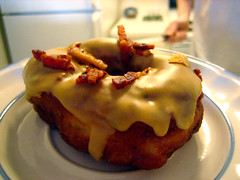 And the answer is simple. Yes. Why, yes you can. Have you ever heard of a maple-bacon doughnut? This takes it to a new level, because now we’re adding one of America’s great culinary contributions to the world – bacon (and I don’t mean the Canadian variety, sorry Canada), and maple syrup, which is almost as American as apples (sorry again Canada, but Vermont maple syrup is better).
Hopefully I’ve inspired you to try cider and donuts for breakfast this weekend. If you’ve never had this combination and you do try it, let me know what you think. If you like it, please don’t hesitate to send me a finder’s fee of some slab bacon or other delicious pork product. Just send it to Park City, Utah. They’ll know to deliver it to the guy with the pig tattoo. No COD please.
Thanks for listening.
Arousing the Senses with a Nice Pair
Posted: July 2, 2012 Filed under: Beer, Cheese, Food, Food Pairings | Tags: Beer, beer and cheese, beer and cheese pairings, Blue cheese, Brooklyn Brewery, Brown Ale, Cheese, cheese pairing, India Pale Ale 8 Comments Hands down, two of my most favorite foods are beer and cheese. I will be so bold as to say that my very existence relies upon a perpetual supply of both. If I didn’t have either, I expect I would shrivel up and blow away into the crisp Rocky Mountain wind.
It’s not by accident that I love these two foods. They are actually perfect bedfellows…and I personally believe an even better pairing than wine and cheese. (I can almost hear the wine enthusiasts shouting, Blasphemer!)
At least listen to my reasoning behind this outrageous claim.
Firstly, both foods rely upon microbial activity and when made well, can reflect the terroir (sorry for using that word again) of the area in which it is made.
Secondly, cheese is earthy, pungent and intense, usually with a creamy finish that  can overwhelm the flavor of other libations. Beer has similar flavor profiles as that of many cheeses, but also has carbonation, bitterness and roasted flavors that can handle the richness and creaminess of most cheeses.
I probably haven’t convinced you yet, but I’ve always felt the best way to persuade somebody is to have them experience it for themselves. Therefore, I will list for you some of the best pairings of cheese and beer and you can decide for yourself if I’m accurate in my statement above.

On a final note, here are some fundamentals behind pairing beer and cheese so you can try your own combinations (from the brain and experience of Garrett Oliver, brewmaster at Brooklyn Brewery and famed author). There aren’t any hard fast rules, so try, try and try again until you find what you prefer.
— lighter beers with younger or fresh cheeses
— malty beers with nutty, aged cheeses
— hoppy beers with tart, sharp cheeses
— strong, sweet beers with blue cheeses
The beauty of pairing beer and cheese is you can taste away until you find the perfect pairing. If you have any favorites of your own, please don’t hesitate to include them below.
Thanks.
Related articles
- 5@5 – Cheeses that pair well with beer (eatocracy.cnn.com)
Farmers Markets: My Practical Food Obsession
Posted: June 15, 2012 Filed under: Farmers Markets, Farms, Food | Tags: Downtown Salt Lake City Farmers Market, Farmer, Farmers Market, Food, Market, Park City Farmers Market, Park Silly Sunday Market, Utah 2 Comments
Park Silly Sunday Market
Believe it or not, my fiancé Kylie and I went to three farmers markets over the last week. I know, a little extreme, but these were the first of the year here in the Park City area and we couldn’t help but indulge our food obsession and see what the new season has to offer. We started off at the Park City Farmers Market at the Canyons on Wednesday, then went to the Downtown Salt Lake City Farmers Market (which is celebrating it’s 20th anniversary) on Saturday and finished with the Park Silly Sunday Market.
These are the three main farmers in our area, but we aren’t the only ones in the US who are lucky enough to have a number of markets nearby. According to the USDA, in 2011 there were 7,175 farmers markets in the US. That’s almost 4 times more than in 1994 when there were 1,755.
So there seems to be much interest in farmers markets today, so why do people go to them? Well, some people believe there is an environmental and economic benefit. All of this is important, but also debatable, with many scientists and economists debating for and against it.
I personally feel there are more practical and cultural (and maybe selfish) reasons to attend a farmers market. So here are the reasons why I go to farmers markets. They aren’t going to disprove any stuffy economist or scientist, but I personally feel they are hard to argue against.
- Variety – For those who know me, variety is the most important aspect to life. Living in NY, I used to go to three different pizzerias on a Friday night because one made the best grandma slice, another the best white slice and the last one a killer Sicilian vodka slice. Good farmers markets will offer a variety of vendors and producers who may introduce you to something new. Maybe the ramps are in season or its the garlic shoots. Did you know there’s saffron being grown in Utah? I didn’t until last Saturday. And guess what, we bought a bunch of bulbs so we can try to grow our own.
- Sampling– OK, so this is the frugalness in me coming out, but vendors at farmers markets typically offer the chance to try it before you buy it. Maybe it’s unusual, all natural preserves or a unique pickle. You don’t need to buy a whole jar to find out that you don’t like it.

Heirloom Tomatoes 2 ERD (Photo credit: Wikipedia)
- Food knowledge– The farmers market is the perfect opportunity to talk to the growers and producers to learn how single source honey is harvested or a sheeps milk bloomy rind cheese is aged or all natural preserves are canned. Having this knowledge connects us closer to our food and creates a deeper appreciation for how its made.
- Taste – All I’m going to say is that I prefer the taste of a tomato that is grown nearby and ripened on the vine than one that is grown 2,000 miles away and ripened in the back of a trailer. If I have a little extra money in my pocket, I’ll choose the farmers market tomato every time.
- Community – If you don’t want to face potentially large crowds or be exposed to blaring music than don’t bother coming to most farmers markets. They are created to draw people together, help them forget about their everyday lives and sell them some locally produced food. You may make a new friend…you may not. It is healthy for a community to interact with each other in a positive way. If you’re a psychopath and don’t see value in this, enjoy the rest of your lonely existence.
- Innovation – Markets are also starting to inspire collaboration among the producers. At the farmers market in Salt Lake,
 Squatters Brewery created a brew called Bumper Crop that is a honey ale made with locally harvested honey and locally grown lavender. It has a floral head and an effervescent finish. The best part is that $1 from each large bottle of beer goes back to the farmers market. Without the farmers market, we wouldn’t have experienced such a tasty brew.


These are my reasons, though I’m curious to hear why you do or don’t go to farmers markets. Y0u can respond in the box below. We won’t judge you. I promise.
Thanks again for your time.

